Global Diesel Markets Tighten as Ukraine Strikes Cripple Russian Refining
Moscow banned diesel exports on July 8 after months of Ukrainian drone attacks knocked out roughly a quarter of Russian refining capacity, and the world's diesel market is paying for it.

Russia stopped selling diesel to the world on July 8, and the fuel that keeps trucks, tractors, and standby generators running got more expensive almost everywhere at once. Deputy Prime Minister Alexander Novak confirmed the export ban, saying it would let the Kremlin "increase supplies to the domestic market." The trigger was not a decision made in Moscow so much as one forced on it: after months of Ukrainian drone strikes, Russia no longer has enough working refineries to supply its own drivers and export the surplus. Something had to give, and it was the export barrel.
The immediate reaction was violent. European diesel refining margins climbed to roughly $60 a barrel, a record, as traders scrambled to replace a supplier that shipped about 11 percent of the world's seaborne diesel last year. U.S. diesel futures posted one of their sharpest one-day moves in years. This is not a story about a single ban. It is about a supply system that had been fraying for the better part of a year finally snapping.
How the refineries went dark
Ukraine spent the spring and early summer methodically working through Russia's refining map. By early July its drones had hit the majority of Russia's large refineries in a campaign of roughly 50 strikes over about 100 days, some raids reportedly involving hundreds of drones at once. Two July attacks pushed the situation past the tipping point. On July 6, drones struck Omsk, Russia's single largest refinery, more than 2,000 kilometers from the front line, damaging primary crude distillation units. A day later, the Saratov refinery was hit and halted.
The cumulative damage is large by any measure, though the exact figure depends on who is counting. The International Energy Agency put the loss at more than 20 percent of Russian refining capacity. Ukraine's General Staff claimed nearly 43 percent had been disabled at one point in early July. Finland's president cited a 40 percent reduction. Russian crude processing fell to about 3.9 million barrels a day in early July, the weakest reading since 2005. Whatever the precise share, the direction is not in dispute: a lot of Russia's ability to turn crude into diesel is offline, and it is not coming back quickly.
The export barrel was the first casualty
Russia's diesel shipments were already collapsing before the formal ban made it official. Seaborne diesel and gasoil exports fell 39 percent in June from May, to roughly 1.8 million metric tons, and were down about 46 percent from a year earlier. By early June, some measures had Russian diesel exports down more than half year over year. The July 8 decree, set to run through July 31, simply closed the door on what was left.
Do not assume that deadline is real. Russia banned diesel exports in 2023 and then extended it. With refinery repairs measured in months, not weeks, and drone strikes continuing, the base case is that the ban gets rolled forward rather than lifted on schedule. Traders are pricing it that way. Goldman Sachs told clients to take a long position in the December 2026 to March 2027 European diesel timespread, a bet that the tightness lasts well into winter, which is precisely when diesel and heating oil demand peaks in the Northern Hemisphere.
Why the whole world feels a Russian shortage
Diesel is the fungible workhorse of the fuel complex. It moves freight, plants and harvests crops, powers construction and mining equipment, and increasingly backs up data centers and power grids. Because it trades globally, a hole in one region gets filled by pulling cargoes from another, which lifts prices along the whole chain. When Russia stops exporting, buyers in Europe, Turkey, Brazil, and Africa go hunting for the same replacement barrels from the United States, the Middle East, and India, and they bid against each other to get them.
The timing made it worse. The diesel market was already tight from the Iran war, which had squeezed the same pool of Middle Eastern and refined-product supply that would normally cushion a Russian outage. Two shocks drawing on one shrinking pool is how you get record margins. Refiners outside Russia are the clear winners here: a barrel of crude turned into diesel is worth far more than it was a month ago, and that is showing up directly in refining profitability.
What it means at the pump and in the field
For anyone who buys diesel by the truckload, the mechanism is simple and unpleasant. Higher wholesale diesel and fatter crack spreads feed into freight rates, farm operating costs, and the price of running a generator. Trucking and agriculture have the least room to absorb it, because diesel is a big, non-optional line item and there is no quick substitute. Expect it to leak into the cost of moving and growing almost everything over the coming weeks, with the lag depending on local contract structures and taxes.
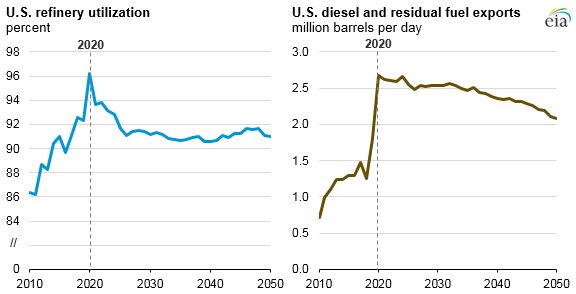
Retail gasoline and diesel prices in the U.S. are less exposed than the futures screens suggest, because American refiners are running hard and the country is a net exporter of diesel. The pressure is real but indirect, arriving through global prices rather than a domestic shortage. Europe is the more vulnerable buyer, having leaned on Russian-linked diesel flows for years and now competing for the marginal cargo.
The bind Moscow can't easily escape
Russia's problem is that the export ban treats a symptom. It keeps more diesel at home, but it does nothing to rebuild refining capacity, and it costs the state export revenue at a moment when the war is expensive. The domestic side is already strained: gasoline production has run below summer demand, independent stations have faced rationing, and Crimea declared a fuel emergency in late June. Moscow has resorted to importing gasoline from India and Belarus, an awkward position for one of the world's largest crude producers.
The refineries are the constraint, and they are hard to defend across thousands of kilometers of territory. Until Russia can either protect those plants or repair them faster than Ukraine can hit them, the export barrel stays offline and the global market stays tight. For diesel buyers everywhere, the sensible planning assumption is not that this eases by August. It is that elevated prices and thin spare supply are the setting for the rest of the year, with winter demand still ahead.
Sources
https://oilprice.com/Energy/Crude-Oil/As-Ukraine-Cripples-Russian-Refining-Global-Diesel-Markets-Pay-the-Price.htmlhttps://en.wikipedia.org/wiki/2025%E2%80%932026_Russian_fuel_crisishttps://www.cnn.com/2026/07/09/business/russia-diesel-ban-ukrainian-strikes-intlhttps://www.bloomberg.com/news/articles/2026-07-08/russia-bans-diesel-exports-after-ukraine-s-refinery-attackshttps://www.usnews.com/news/world/articles/2026-07-08/russia-bans-diesel-exports-to-ensure-domestic-supply-after-targeted-ukrainian-drone-strikeshttps://www.themoscowtimes.com/2026/07/08/russia-bans-diesel-exports-to-ensure-domestic-supply-after-targeted-ukrainian-drone-strikes-a93202