Why Natural Gas Prices Go Negative at Waha: The Physics of Stranded Associated Gas
In the Permian, gas is a byproduct of oil, and when the pipes fill up producers will literally pay to hand it off, which is why the Waha Hub keeps printing prices below zero.

On March 11, 2026, spot gas at the Waha Hub in West Texas settled at roughly minus $7.15 per MMBtu. Read that again. A seller of a real physical commodity paid a counterparty more than seven dollars for every million British thermal units to take gas off their hands. That was the 25th trading day in a row Waha closed below zero, and the 34th day of the year at that point, according to Reuters data carried by BOE Report. This is not a glitch in a screen. It is the market doing exactly what it should when you produce a product nobody at that location can move and almost nobody there wants.
To understand why, you have to stop thinking of Permian gas as a gas business. It is an oil business with a gas problem.
Gas the drillers never wanted
Every barrel of crude that comes up out of the Wolfcamp and Bone Spring brings dissolved and associated natural gas with it. Operators in the Delaware and Midland basins are drilling for oil economics. The gas is a byproduct, and the gas-to-oil ratio in a lot of these wells climbs as they age. Nobody sinks a $9 million lateral in Reeves County because Henry Hub looks attractive. They drill because WTI clears their breakeven, and the gas comes up whether the gas price is $3, thirty cents, or negative.
That is the core of it. Associated gas supply is inelastic to the gas price. A conventional dry-gas producer in Appalachia can throttle back when Henry Hub sags. A Permian oil driller cannot shut in the gas without shutting in the oil, and the oil is where the money is. So when takeaway pipe out of the basin fills up, the gas has nowhere to go, and the only way to clear the market is to make it worth someone's while to physically accept the molecules. The price falls until it goes negative.
Pipes, not demand, set the ceiling
Waha is a hub, but it is a landlocked one. Its price is really a story about the pipelines heading east to the Gulf Coast and south into Mexico. When long-haul takeaway is full, or a line goes down for maintenance, gas backs up behind the constraint and Waha decouples from the rest of the country. The relevant number isn't national gas demand. It's the spread between Permian production and the sum of the pipes leaving the basin on any given day.
The math got ugly because production outran steel. Permian gas output has more than doubled since 2018 per the U.S. Energy Information Administration, and hit a record of about 27.7 Bcf/d in 2025. Pipeline capacity is lumpy. It arrives in 2 to 2.5 Bcf/d chunks every couple of years, not in a smooth curve. In between, the basin overproduces its own exits. 2024 was the worst of it: Waha printed below zero on 46% of trading days, with a low of minus $6.41 on August 29, 2024, and a basis roughly $2.07 under Henry Hub for the year.
When the safety valve is a flame
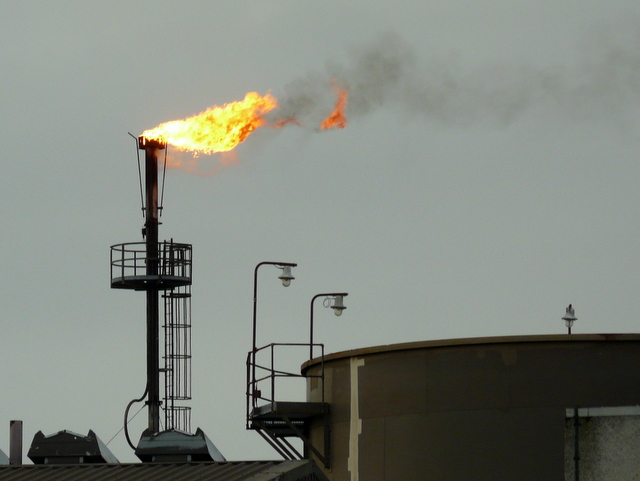
There is a release valve for stranded gas, and you can see it from space. Flaring. If an operator can't sell the gas and can't store it, the historical answer was to burn it at the wellhead. Texas flare volumes climbed from around 35 Bcf in 2011 to roughly 263 Bcf in 2020, tracking the drilling ramp and the failure of midstream to keep pace.
The Texas Railroad Commission regulates this under Statewide Rule 32, and to flare beyond routine operations an operator has to hold a permit, good for up to six months and renewable. The politics here matter for prices. When the RRC issues flare permits freely, negative Waha prices are capped in a sense, because burning gas is an alternative to paying someone to take it. As the Commission has tightened its posture and operators face methane scrutiny and their own emissions targets, flaring becomes a less available escape hatch. Squeeze the flare option and more gas has to clear through the pipe, which pushes the marginal molecule harder into negative territory when the pipe is full. The Environmental Defense Fund's Permian measurements have argued real methane emissions run well above EPA estimates, which keeps the pressure on to move gas rather than vent or burn it.
Matterhorn helped, then the glut caught up
New pipe is the only durable fix, and it works. The Matterhorn Express Pipeline, a 2.5 Bcf/d, roughly 490-mile, 42-inch line from Waha to Katy, Texas, run by a joint venture including WhiteWater, EnLink, Devon, and MPLX, began initial flows in September 2024. You could see it in the tape. Waha firmed through late 2024 and into 2025 as Matterhorn ramped, and the 2025 average clawed back to around $1.15 per MMBtu after 2024's disaster.
Then production filled the new pipe. By 2026 Waha was back below zero on a record streak, because output kept climbing while the next tranche of capacity hadn't shown up yet. The EIA has flagged another wave of approved projects: Apex at 2.0 Bcf/d to Port Arthur and Blackcomb at 2.5 Bcf/d to Agua Dulce, both targeting 2026, plus Saguaro Connector at 2.8 Bcf/d toward the Mexican border later in the decade. Energy Transfer's Hugh Brinson line is in the mix too. Roughly 7.3 Bcf/d of new exits are lined up.
Why this keeps happening
Here is the pattern, and it is structural, not a one-off. Oil-directed drilling produces gas the driller doesn't care about. That gas is price-inelastic, so it shows up no matter what Waha does. Pipeline capacity comes in big discrete jumps, so the basin oscillates between tight and slack. A new line lands, prices recover, drilling and gas-oil ratios climb, the line fills, and Waha goes negative again until the next one opens. Flaring rules set the floor on how negative it can get before burning becomes the cheaper option.
So the negative print at Waha isn't irrational and it isn't a market failure. It's the honest price of a molecule that exists only because someone wanted the oil next to it, in a place with more gas than pipe. Matterhorn bought a reprieve. Apex and Blackcomb will buy the next one. But as long as the Permian is drilled for crude and the gas comes up for free, Waha will keep testing zero from the wrong side every time production laps the pipelines. Watch the in-service dates on those 2026 lines. They tell you when the next reprieve starts, and roughly how long it lasts before the drill bit erases it again.
Sources
https://boereport.com/2026/03/12/us-natgas-prices-at-waha-hub-in-texas-remain-negative-for-record-25th-day/https://www.eia.gov/todayinenergy/detail.php?id=63044https://naturalgasintel.com/news/matterhorn-expansion-ramp-up-fails-to-arrest-negative-permian-price-run/https://pgjonline.com/news/2025/september/permian-waha-hub-gas-prices-turn-negative-amid-pipeline-constraintshttps://www.lexology.com/library/detail.aspx?g=7b66ff9d-592b-4c7b-a6f9-567dd6bbd68dhttps://www.vaneck.com/us/en/blogs/natural-resources/waha-no-longer-just-giving-natural-gas-away/