US Seizes the 'Skipper' Tanker Off Venezuela and Hauls Its Crude to Texas
American commandos boarded the very large crude carrier Skipper in Caribbean waters on December 10, then steered its 1.85 million barrels of Venezuelan crude toward the Texas Gulf Coast.

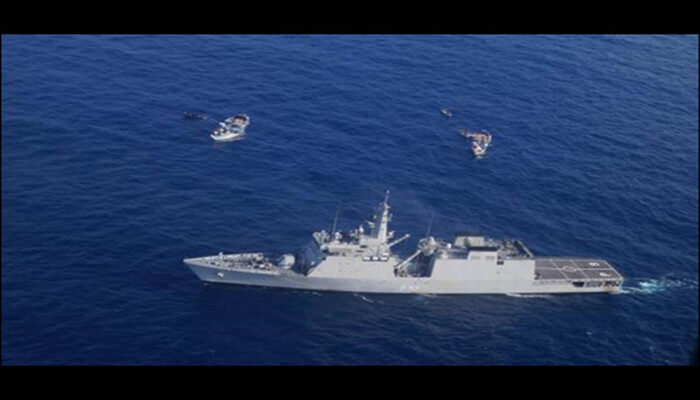
On the morning of December 10, ten Coast Guard Maritime Security Response Team operators and ten Marine special operators fast-roped from two helicopters launched off the aircraft carrier USS Gerald R. Ford and took control of a very large crude carrier called the Skipper. The ship had left Venezuela's Puerto Jose terminal on December 4 carrying roughly 1.85 million barrels of PDVSA crude. It was flying a Guyanese flag it had no right to fly. Within days, the seized vessel was tracked steaming toward Houston, and by December 22 marine-traffic feeds put it about 40 miles off Galveston.
This is the first time in the current pressure campaign that Washington has physically taken a laden tanker off Venezuela's coast and brought both ship and cargo to the United States. It is not a sanction, not a designation, not a warning letter. It is a boarding party, a prize crew, and a cargo bound for a US port. Nicolas Maduro's government called it "an act of international piracy" and said the crew had been "kidnapped."
What the boarding party found
The Skipper, IMO 9304667, is a 310,000-deadweight-ton VLCC formerly named Adisa. Its registered owner is Triton Navigation Corp. of the Marshall Islands; its operator is a Nigeria-based outfit, Thomarose Global Ventures. Both are the kind of thin, disposable corporate shells that populate the so-called shadow fleet, the loose grouping of roughly a thousand aging tankers that move sanctioned Russian, Iranian, and Venezuelan barrels around price caps and embargoes.
The cargo was Merey, the heavy, high-sulphur blend that is Venezuela's export workhorse. It loaded at Jose, the country's main crude terminal, between December 4 and 5. Then the Skipper did what shadow-fleet ships do: shortly after departure, near Curacao, it lightered a portion of its oil, around 200,000 barrels, onto a Panama-flagged tanker named Neptune 6 that was headed for Cuba. That ship-to-ship transfer is one of the ways Caracas keeps oil flowing to Havana while muddying the paper trail. It also gave US investigators a clean example of exactly the sanctions evasion the seizure warrant described.
The warrant, and the clock
The legal spine of this operation is a federal seizure warrant. Court documents unsealed afterward show US Magistrate Judge Zia Faruqui signed it on November 26 in the District of Columbia. The warrant carried a hard deadline: the government had until December 10 to take the ship. The Coast Guard boarded on the 10th, the day the authorization was set to expire. Attorney General Pam Bondi announced the seizure publicly, video included, and President Trump confirmed it.
The government's theory rests on more than sanctions law. Officials invoked the "right of visit" under the UN Convention on the Law of the Sea, arguing that a vessel falsely claiming Guyanese registry is effectively stateless and open to boarding on the high seas. Guyana's flag registry has not vouched for the ship. That false-flag element matters, because it is the legal hook that lets US forces act in international waters rather than someone else's territorial sea. The boarding happened between Grenada and Trinidad, well off Venezuela's coast.
Why the cargo is heading to a Texas dock
Once a US court has jurisdiction over property alleged to be sanctions-tainted, the physical asset can be brought in and held for forfeiture proceedings. That is why the Skipper is sitting off Galveston rather than being escorted to a neutral anchorage. The crude will most plausibly be discharged into Gulf Coast storage while the forfeiture case runs, and Merey has a natural home there: US Gulf refiners were built to run heavy Venezuelan barrels and did so for decades before sanctions cut the flow.
There is a real question of who owns the oil in the meantime. Reporting on the seizure indicated a large share of the cargo was tied to Cuba's state importer, which is part of why the Neptune 6 transfer drew scrutiny. Sorting title to 1.85 million barrels of contested crude is not a dockside decision. It is litigation, and it will take months.
Caracas takes it to the Security Council
Maduro's response was fast and loud. "They have ushered in a new era, the era of criminal naval piracy," he said. The Foreign Ministry framed the whole US campaign around resources rather than the stated rationale of migration or drug trafficking: "It was always about our natural resources." Foreign Minister Ivan Gil said Venezuela delivered a letter to the presidency of the UN Security Council formally condemning the seizure, and Caracas has since floated criminalizing such boardings under its own law.
Not everyone in Venezuela objected. Opposition leader Maria Corina Machado applauded the operation, arguing the government uses black-market oil revenue "to repress and persecute our people." That split, a government screaming piracy and an opposition cheering enforcement, is the political texture Washington is counting on as it squeezes Maduro's cash.
What this signals for the shadow fleet
Designations and secondary sanctions have been the tools of choice against sanctioned oil for years. They raise costs and freight rates, but the barrels keep moving because the ships are cheap, the owners are anonymous, and enforcement rarely reaches the steel itself. Boarding a laden VLCC and sailing it to Texas is a different order of deterrence. It puts every shadow-fleet operator moving Venezuelan crude on notice that a false flag and a mid-ocean transfer are not enough cover.
The follow-through came quickly. Within about ten days, US forces seized a second tanker off Venezuela in international waters, and Washington sanctioned six more ships. Whether this hardens into a durable blockade or stays a handful of high-profile grabs depends on appetite for the naval and legal effort each one demands. Every seizure needs a warrant, a boarding team, a prize crew, and a forfeiture case. That is expensive and slow.
For now, the signal is unambiguous. A tanker that left Jose on a Thursday was under a US prize crew by the following Wednesday and anchored off Galveston two weeks later. The cargo that was supposed to fund the government in Caracas, and partly resupply Havana, is instead waiting to be discharged into a Texas refinery's tanks. For the shadow fleet, the calculus just changed.
Sources
https://en.wikipedia.org/wiki/United_States_seizure_of_the_oil_tanker_Skipperhttps://www.pbs.org/newshour/world/seizure-of-rogue-oil-tanker-off-venezuela-signals-new-u-s-crackdown-on-shadow-fleethttps://www.aljazeera.com/news/2025/12/11/act-of-piracy-or-law-can-the-us-legally-seize-a-venezuelan-tankerhttps://www.houstonpublicmedia.org/articles/news/local/2025/12/22/539435/galveston-oil-tanker-venezuela-maduro-trump-white-house/https://www.justice.gov/usao-dc/pr/us-unseals-warrant-tanker-seized-coast-guard-coast-venezuelahttps://time.com/7340189/venezuela-trump-administration-maduro-oil-tanker-seized-piracy/