Trump Vows US Oil Majors Will Rebuild Venezuela's Industry After Maduro's Ouster
Hours after Nicolas Maduro was flown to New York in US custody, the president said American oil companies would take over Venezuela's fields, sell the crude abroad and repay the United States for what he called stolen assets.

Nicolas Maduro had been in American hands for only a few hours when President Trump turned the conversation to oil. Speaking at Mar-a-Lago on Saturday, January 3, after a pre-dawn US military raid on Caracas seized the Venezuelan leader and his wife, Trump laid out a plan that has nothing to do with courts or transition governments and everything to do with barrels. American oil majors, he said, would move into Venezuela, spend billions rebuilding the wrecked infrastructure, pump the crude, sell it on world markets and hand the proceeds back toward the United States.
"We built Venezuela's oil industry with American talent, drive and skill, and the socialist regime stole it from us," Trump said. He accused Caracas of having "unilaterally seized and sold American oil, American assets and American platforms, costing us billions and billions of dollars." Then the pitch: "We are going to have our very large United States oil companies go in, spend billions of dollars, fix the badly broken oil infrastructure and start making money for the country."
What Trump is actually proposing
Strip away the grievance and the plan is a reimbursement scheme dressed as reconstruction. US companies front the capital to repair pipelines, upgraders and offshore platforms that have decayed under years of underinvestment and sanctions. They export the oil. Revenue flows back to cover what Washington spent and what Trump claims Venezuela owes. He framed it, more than once, as America collecting on a debt it says was stolen.
The mechanism was vague on the day, and it stayed vague. Trump did not put a legal structure on it, did not name a contracting authority, and did not explain who in Venezuela would sign anything. That matters, because there is no recognized government in Caracas to grant concessions. Trump himself said the United States would "run the country" temporarily, "until we can do a safe, proper and judicious transition" of power. An oil deal signed with a US military administration is not the same as one signed with a sovereign Venezuelan state, and every company weighing this knows it.
The 'stolen oil' claim doesn't hold up
Trump's core justification is that the oil was taken from America. It was not. Venezuela nationalized its oil industry in 1975, a sovereign act taken after decades of foreign control dating back to the Juan Vicente Gomez era. At the time it was, in the words of economist Francisco Rodriguez, "relatively uncontroversial" in Washington, which preferred a stable cheap supplier to a production collapse.
US firms did lose assets. Exxon, Mobil and Gulf, the predecessor to part of Chevron, each surrendered roughly $5 billion in holdings and each received about $1 billion in compensation. They did not press for more, in part because there was no obvious legal forum to do it in. That is a settled expropriation from half a century ago, not a theft. A later round of nationalizations under Hugo Chavez did trigger arbitration, and companies like ExxonMobil and ConocoPhillips spent years pursuing awards. None of that makes the oil American property, and international law experts point out that seizing another country's resources through invasion runs straight into the Hague Convention of 1907, which bars pillage and protects private property even in wartime.
The companies aren't buying it
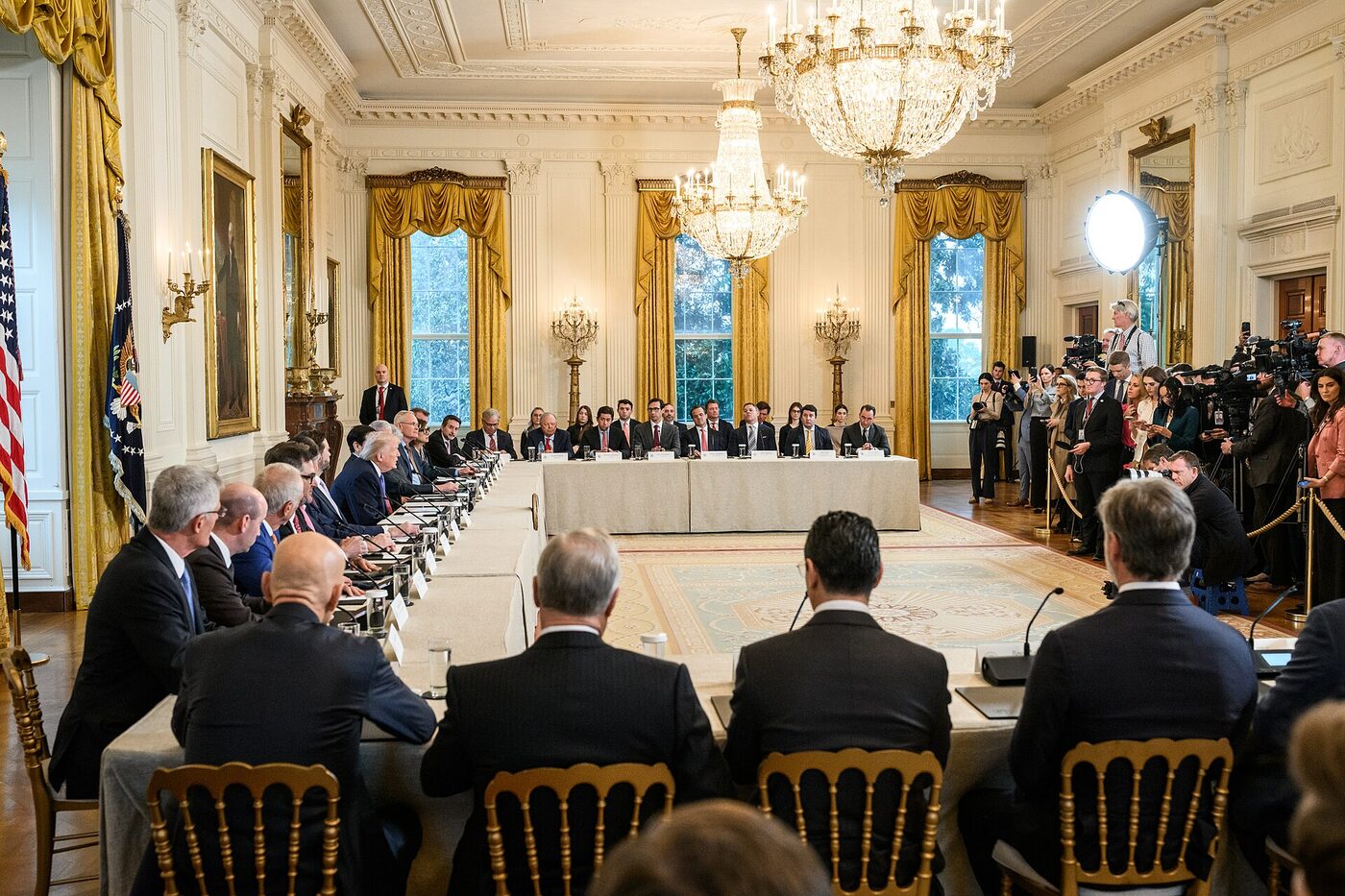
Within days the enthusiasm gap became obvious. Trump gathered more than a dozen energy executives at the White House, including people from Exxon, Chevron, ConocoPhillips, Halliburton, Valero and Marathon, and put a number on the table: at least $100 billion of investment to rebuild the sector, with US protection. The room was polite and unconvinced.
ExxonMobil chief executive Darren Woods said the quiet part out loud. "We've had our assets seized there twice and so, you can imagine, to re-enter a third time would require some pretty significant changes," he said, adding that under the legal and commercial frameworks as they stand "today, it's uninvestable." That is not a hedge. That is the largest US oil company telling the president that his headline project does not clear a basic screen.
Chevron is the one major that never fully left. It has operated under a US license even through the toughest sanctions years, which gives it a running start and also gives it the most to lose from a chaotic free-for-all. Everyone else is being asked to bet capital that pays off only if Venezuela becomes politically stable, legally predictable and physically secure at the same time. Nothing about a country the day after a foreign military raid on its capital suggests all three are imminent.
Why the money doesn't pencil out yet
Venezuela sits on the largest proven crude reserves on the planet, so the prize is real. Getting to it is the problem. The Orinoco Belt produces heavy, sour crude that needs upgraders and specialized refining, and much of that plant is degraded. Production has fallen a long way from its early-2000s peaks. Rebuilding is a multiyear, multibillion-dollar commitment that only makes sense against contracts a company can enforce.
Right now those contracts don't exist. A US-installed administration cannot durably hand out oil rights, sanctions relief is unclear, and any future elected Venezuelan government could challenge deals struck during the occupation. Add real physical risk to workers and installations, and the $100 billion figure looks less like a plan than an opening bid. The executives who nodded through the White House meeting will not deploy serious capital until Washington produces a legal structure, a sanctions carve-out and a counterparty that will still be standing in five years.
What to watch next
The tell will be whether the administration converts rhetoric into a framework: a defined licensing authority, clear sanctions guidance, and some form of investment protection that survives a change of government in Caracas. Watch Chevron, which is best positioned to expand quietly if terms firm up, and watch whether Exxon softens its "uninvestable" line after any legal changes. Watch, too, for how a transition government, whenever one exists, treats deals cut while US forces controlled the country.
For now the gap between the podium and the boardroom is wide. Trump is selling reconstruction as repayment for a theft that the historical record does not support, to companies that have been burned in Venezuela before and are saying so on the record. The reserves will still be there when the politics settle. Whether American majors put real money behind the president's promise depends on answers he has not yet given.
Sources
https://www.foxbusiness.com/politics/we-built-venezuelas-oil-industry-trump-vows-us-energy-return-after-maduro-capturehttps://www.axios.com/2026/01/03/venezuela-oil-maduro-trump-involvementhttps://www.cnbc.com/2026/01/09/trump-venezuela-oil-executives-white-house-meeting.htmlhttps://www.aljazeera.com/news/2026/1/4/fact-checking-trump-following-us-capture-of-venezuelas-madurohttps://news.usni.org/2026/01/03/maduro-wife-captured-by-american-forces-u-s-to-oversee-venezuela-ahead-of-new-government-trump-sayshttps://www.npr.org/2026/01/03/nx-s1-5665729/u-s-will-run-venezuela-after-military-seized-maduro-president-trump-says