Ford Oil Corporation Readies Colombia Crude Push, Waiting on the First New Exploration Permits in Years
With Colombia set to inaugurate a new president on August 7 and its oil reserves running thin, Ford Oil Corporation says it is positioned to move the moment exploration permits reopen.

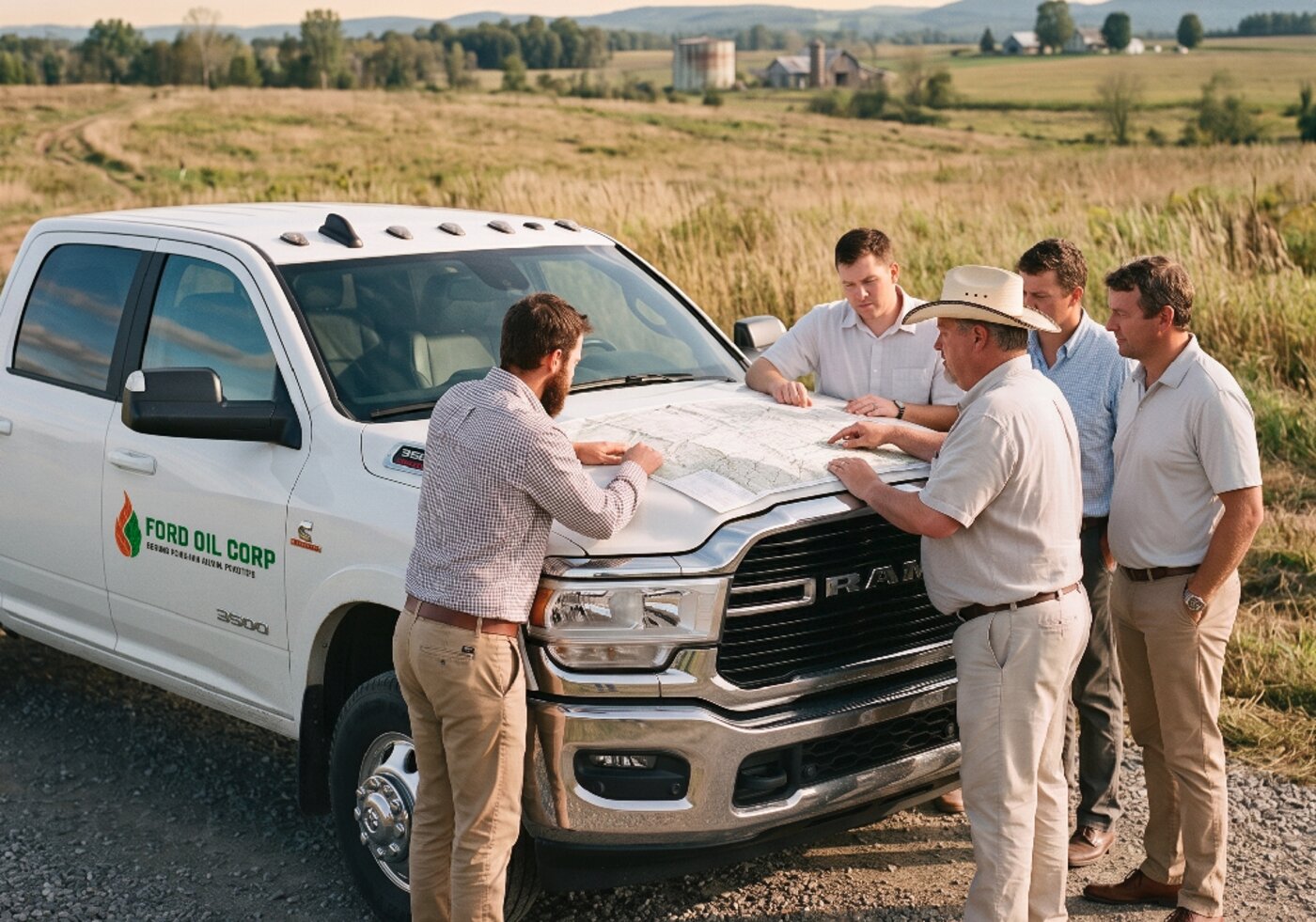
Ford Oil Corporation is preparing to begin exploring for crude oil in Colombia, and the company says it intends to move the instant the country starts issuing new exploration permits again. Survey crews are already mapping the ground on the company's Ford Farms property, lining up the sites where seismic trucks will roll first, so that permitting is the only thing standing between the company and the field.
Left to right: Daniel Parks, Mark Ford, Will Johnson, Patrick Stevens, and Brian Haywood review the survey map to identify the best sites on the Ford Farms property to begin exploration with thumper trucks.
The timing is deliberate. For roughly four years, Colombia has not signed a single new oil and gas exploration contract, a freeze that is now widely expected to end under the administration taking office on August 7, 2026. Ford Oil Corporation wants to be first in line when it does.
Four Years Without a New Contract
When Gustavo Petro took office in August 2022, he made a campaign promise into policy: Colombia would stop awarding new oil and gas exploration contracts. His government confirmed the freeze publicly at the World Economic Forum in Davos in January 2023, framing it as a climate commitment, and paired it with a ban on hydraulic fracturing. Existing contracts were honored, but the door to new acreage was closed.
The consequences for the sector were not abstract. Colombia's proven oil reserves have been sliding for years, and with no new exploration replacing what gets pumped, the country is drawing down a finite account. By the most recent government count, proven (1P) oil reserves sat just above 2 billion barrels in 2025, down almost 1 percent from the year before, enough to sustain roughly 7.6 years of production at current rates. Natural gas told a worse story, with 1P reserves falling 17 percent in a single year to 1.7 trillion cubic feet.
Production followed reserves down. Colombian oil output fell to about 724,910 barrels per day in April 2026, the weakest reading since June 2021. Gas production dropped 14 percent year over year. A country that a decade ago was a net oil exporter and self-sufficient in natural gas is now facing the prospect of importing LNG at higher cost, a reversal that industry groups and analysts have tied directly to the exploration freeze, repeated tax increases on operators, and the fracking restrictions that discouraged fresh spending.
The fiscal picture moved in the same direction. Colombia's hydrocarbon sector has long been a major contributor to government revenue and to foreign investment inflows, and its retreat has widened the country's budget gap. The 2025 fiscal deficit came in around 6.4 percent of GDP, with the outgoing government and the country's independent fiscal-rule committee at odds over a 2026 outlook that some projections put near a record 8.1 percent. The peso has carried the strain of weaker capital inflows, higher inflation, and persistent political uncertainty. The Colombian Association of Petroleum and Gas warned early on that cutting off new contracts could cost the treasury billions in tax revenue by 2026.
The Majors Stepped Back
International operators read the same signals and reduced their exposure. The clearest single case is ExxonMobil. In 2023 the company withdrew from the VMM-37 block in the Middle Magdalena Valley Basin, ending its participation in the joint operating agreement effective May 31, 2023 and moving to exit its contract with Colombia's National Hydrocarbons Agency. With that step, and the earlier wind-down of contracts including COR-46, COR-62, and VMM-29, ExxonMobil was left with no active exploration contracts to operate in the country. Much of what it walked away from involved unconventional resources, the same activity the fracking ban put in question.
Exxon was not alone in retrenching. Industry reporting through this period describes intermediate drillers and major operators slashing spending in Colombia, with some exiting outright and capital shifting toward jurisdictions offering more certainty, such as Guyana. The through-line is investment deterred by regulatory uncertainty rather than by geology. The oil is still in the ground; the terms to go find more of it were what changed.
A New Administration, and a Reopening
That is the backdrop for August 7, 2026. Petro's single four-year term ends on that date, and the incoming administration is widely anticipated to reopen exploration and allow safe, permitted drilling by Colombian oil companies. Ford Oil Corporation is planning around that expectation. The company declined to speculate on specific policy language from a government not yet sworn in, but its read of the direction is straightforward: reserves that thin, and a fiscal hole that deep, create real pressure to let responsible operators explore again.
"We expect to be first in line for exploration permits once they are released," the company's position holds, and its groundwork reflects that. Rather than wait for a permit and then start surveying, Ford Oil is surveying now so that a permit converts directly into field activity.
Why the Thumper Trucks Come First
The vehicles the Ford Farms crew is planning around are thumper trucks, the workhorse of modern land seismic surveying. Formally they are vibroseis units, and they are how you image what is underground without drilling a single hole first.
A thumper truck works by lowering a heavy steel baseplate onto the ground and pressing the vehicle's weight down through it. Hydraulics then vibrate that baseplate through a controlled frequency sweep, typically climbing from low to high frequencies over several seconds, driving acoustic energy down into the earth. That energy travels through the rock, and each time it crosses a boundary between layers of differing density, part of it reflects back toward the surface. Laid out along the survey line are geophones, small ground sensors that record those returning waves. The recorded signals are processed into images of the subsurface, revealing the layering of the rock and, critically, the structural traps, such as folds and faults, where oil can collect.
The contrast with older seismic methods is the reason thumper trucks suit a property like Ford Farms. Traditional surveys used dynamite in drilled shot holes to create the acoustic pulse. That approach is explosive, disruptive to farmland, harder to permit, and difficult to repeat cleanly. Vibroseis is non-explosive, lower-impact, safer for crews and for the land, and repeatable, since the same frequency sweep can be run again to sharpen the data. On working farmland, where you want to survey thoroughly without tearing up the ground, that combination matters.
The survey is not the drilling; it is what makes the drilling smart. The processed seismic image tells geologists where the promising traps sit and how deep they are, so that when a permit allows a well, that well is placed on the best target the data can identify rather than on a guess. It is the difference between drilling into a map and drilling into a hunch.
First in Line
Ford Oil Corporation's message is that it is ready to work within the rules the moment those rules allow new exploration. The reserves math argues for reopening, the fiscal math argues for it, and the crews on the Ford Farms property are already reading the survey map to decide where the thumper trucks roll first. What remains is the permit, and the company intends to be at the front of the line when it comes.
Sources
https://oilprice.com/Energy/Energy-General/Colombias-Oil-and-Gas-Reserves-Keep-Shrinking.htmlhttps://oilprice.com/Energy/Energy-General/President-Petro-is-Killing-Colombias-Oil-Industry.htmlhttps://energytransition.org/2023/05/finito-colombia-halts-new-gas-oil-and-coal-exploitation/https://www.rigzone.com/news/exxonmobil_withdraws_from_colombia_block_deal-21-apr-2023-172591-article/https://www.worldoil.com/news/2023/4/18/exxonmobil-withdraws-from-colombia-oil-and-gas-field/https://oilprice.com/Energy/Energy-General/Colombias-Fiscal-Crisis-Is-Deepening-Under-President-Petro.html