Inside a Refinery: How Distillation, Cracking, and Reforming Turn One Barrel Into Dozens of Products
A barrel of crude is a mixed bag of molecules; the refinery's job is to sort them by boiling point, then chemically rebuild the low-value ones into gasoline, diesel, and jet.

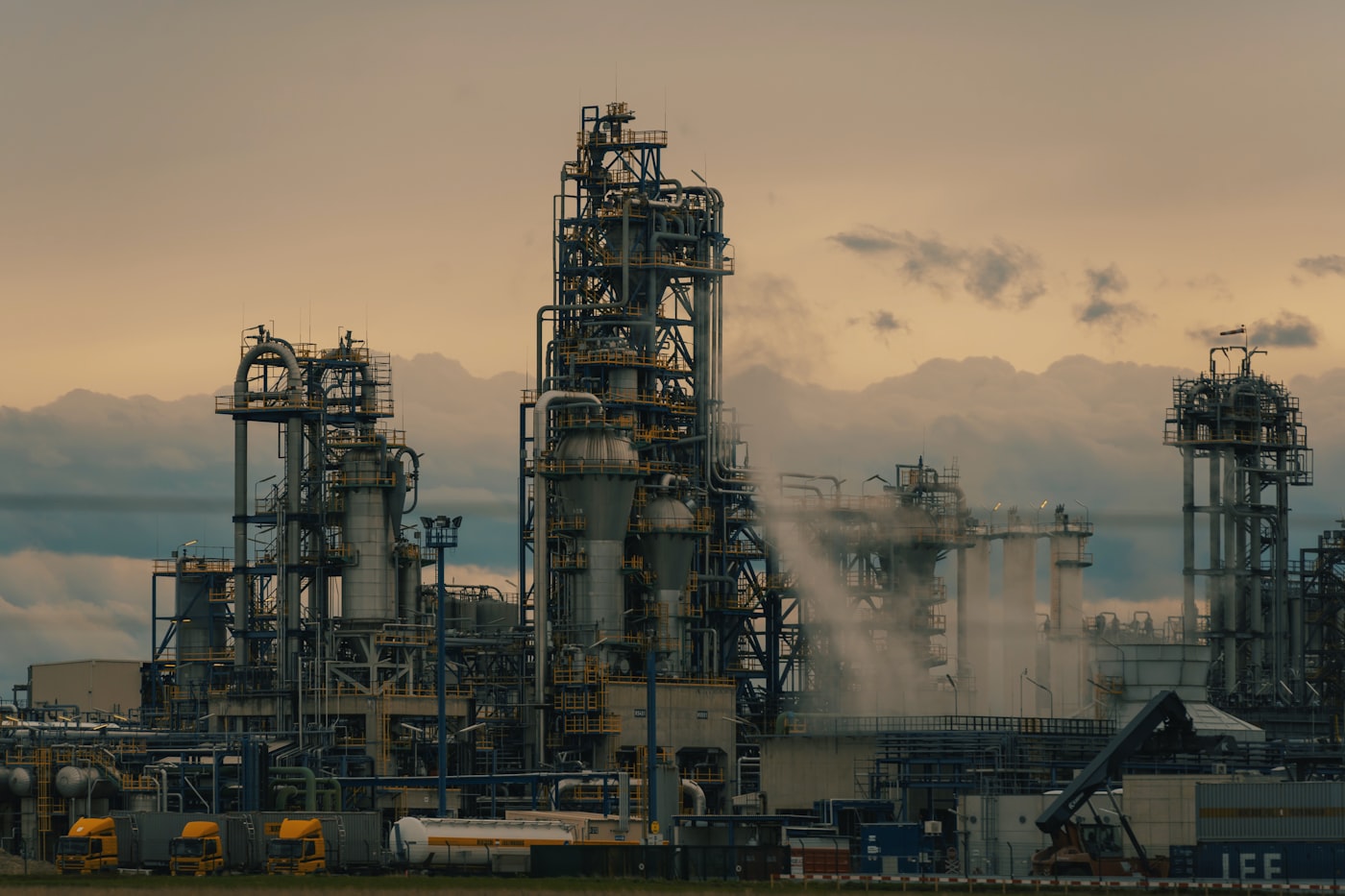
Feed a 42-gallon barrel of crude oil into a U.S. refinery and, on average, you get more than 42 gallons back out. In 2023 the average processing gain ran about 6.3 percent, so a barrel of input produced roughly 45 gallons of finished product: about 19.6 gallons of gasoline, 12.5 gallons of diesel, and 4.4 gallons of jet fuel, according to the U.S. Energy Information Administration. The volume grows partly because finished products are less dense than crude, and partly because the plant breaks big, heavy molecules into smaller, lighter ones. That last part is the whole game. Distillation only sorts what crude already contains. Everything that makes a modern refinery valuable happens after the still.
The boiling-point ladder
Crude arrives as a soup of hydrocarbons ranging from methane to tar. The first unit, the atmospheric distillation column, does nothing chemical to them. It heats the crude in a furnace to somewhere around 350 to 400 degrees Celsius and lets it flash into a tall tower. Inside, temperature falls with height. Molecules rise until they hit a tray cool enough to condense them, then drop out as a side cut. Light, low-boiling fractions climb to the top; heavy, high-boiling fractions stay at the bottom.
The cuts stack in a predictable order. Light and heavy naphtha, the gasoline-range material, boils off roughly between 20 and 200 degrees Celsius. Kerosene and jet come next, around 180 to 270. Diesel and other distillates fall in the range of about 190 to 370. Below that sits atmospheric gas oil, and at the very bottom is the residue that will not boil at atmospheric pressure at all.
That residue is not waste, and refiners refuse to leave it on the table. It goes to the vacuum distillation unit, which pulls a partial vacuum so the heavy stuff boils at a lower temperature without cracking apart from raw heat. Vacuum distillation splits the bottoms into vacuum gas oil, which boils in the neighborhood of 343 to 593 degrees Celsius under normal pressure, and vacuum residue, the thick tar at the very end of the ladder. Those two streams are the feedstock for the units that actually make a refinery money.
Conversion: breaking the heavy stuff down
Straight-run distillation of a typical crude yields far more heavy gas oil and residue than the market wants, and not nearly enough gasoline and diesel. Conversion units fix the mismatch by cracking large molecules into small ones. There are three workhorses.
- The fluid catalytic cracker (FCC). This is the gasoline machine. It takes vacuum gas oil, sprays it onto a hot powdered catalyst at high temperature, and cracks the heavy molecules into gasoline-range and lighter material in seconds. The FCC also throws off propylene and butylenes, light gases that feed the alkylation unit downstream. In a fuels refinery built around gasoline, the FCC is usually the largest conversion unit on site.
- The hydrocracker. Same idea, different chemistry. It cracks heavy gas oil under high hydrogen pressure over a catalyst. The hydrogen saturates the products and strips out sulfur, so a hydrocracker leans toward clean middle distillate: diesel and jet rather than gasoline. Refineries that want to swing yield toward diesel invest here. It is expensive because it consumes a lot of hydrogen and runs at severe pressure.
- The coker. This is the bottom-of-the-barrel unit. It takes vacuum residue, the tar nothing else will touch, and heats it hard enough to crack it into lighter gas oils plus solid petroleum coke. A delayed coker is what lets a refinery run the cheapest, heaviest crudes to near-total extinction instead of selling residue as low-value fuel oil or asphalt.
Treating and rebuilding: making the streams sellable
Cracking gives you smaller molecules, but not always the right ones, and rarely clean ones. A second set of units reshapes and cleans the streams.
The catalytic reformer is the octane factory. Straight-run heavy naphtha off the crude tower has a low octane number and is nearly useless in a gasoline pool as-is. The reformer rearranges those molecules over a platinum catalyst into aromatics and branched structures with much higher octane. It runs at moderate pressure and, as a bonus, produces hydrogen that the hydrotreaters and hydrocracker need. Reforming does not crack the molecule down so much as restructure it.
Alkylation runs the reaction in the other direction. It takes the light olefins the FCC produces, propylene and butylenes, and combines them with isobutane over an acid catalyst into alkylate, a high-octane, low-vapor-pressure blendstock that is one of the cleanest components in the gasoline pool. Reformate brings octane with aromatics; alkylate brings octane without them. Blenders want both.
Underneath all of it sit the hydrotreaters, the least glamorous and most numerous units in the plant. They run individual streams over catalyst under hydrogen to strip sulfur, nitrogen, and metals. Hydrotreating is what lets a refinery meet ultra-low-sulfur diesel and gasoline specs, and it is why a plant that runs high-sulfur sour crude needs far more hydrogen capacity than one running sweet crude. Finally, the blenders combine reformate, alkylate, FCC gasoline, straight-run naphtha, and additives, tuning each batch for octane and vapor pressure to hit the finished spec.
What complexity actually means
All of this hardware is what analysts mean by refinery complexity, and there is a single number for it: the Nelson Complexity Index, developed by Wilbur Nelson in a series of Oil and Gas Journal articles in 1960 and 1961 and elaborated in 1976. The idea is simple. Give the crude distillation unit a value of 1.0, then rate every other unit by its construction cost relative to that column. Vacuum distillation carries a factor near 2.0, catalytic reforming around 5.0, catalytic cracking around 6.0. Multiply each unit's factor by its capacity relative to the crude unit, sum them up, and you get the refinery's index.
The spread is wide. A topping refinery, which is just a distillation column with no conversion, sits near 1.0. A deep-conversion plant with cracking, coking, reforming, and alkylation can reach the mid-teens and beyond. The EIA points to two Phillips 66 plants as a clean illustration: the Ferndale, Washington refinery scores a 7.0 with FCC, alkylation, and hydrotreating, while the Los Angeles refinery hits 14.1 by adding hydrocracking, reforming, and coking. U.S. refineries average around 9.5; European plants run closer to 6.5. Reliance's Jamnagar complex in India, often cited as the most complex in the world, is rated above 21.
Why the complex plants want the ugly crude
Complexity is not vanity. It is what lets a refinery buy cheap and sell dear. Heavy, high-sulfur sour crudes trade at a discount to light, sweet grades precisely because they are hard to process: more residue, more sulfur, more metals. A topping refinery cannot do much with them. A coker-and-hydrocracker plant can take that discounted heavy-sour barrel, crack the residue into gas oil, hydrotreat the sulfur out, and turn the whole thing into ultra-low-sulfur diesel and clean gasoline that sell at full price.
The margin between what a refiner pays for crude and what the finished products fetch is the crack spread, and it is the number that governs whether these plants run hard or throttle back. A simple refinery captures the crack spread only on the light ends it can make. A complex one captures it on nearly the entire barrel, including the parts a simpler plant would have dumped into low-value fuel oil. That is the entire economic case for spending billions on cokers and hydrocrackers: complexity converts a crude-quality discount into product-quality margin.
So when you watch diesel cracks blow out or gasoline margins collapse, remember that the refinery is not one machine but a sequence of them, each one taking the leftovers of the last and dragging value up the boiling-point ladder. Distillation sorts the barrel. Conversion and treating rebuild it. The gap between those two capabilities, priced in a single index, is most of what separates a refinery that survives a bad margin year from one that gets idled.
Sources
https://www.eia.gov/energyexplained/oil-and-petroleum-products/refining-crude-oil-the-refining-process.phphttps://www.eia.gov/energyexplained/oil-and-petroleum-products/refining-crude-oil-inputs-and-outputs.phphttps://www.eia.gov/todayinenergy/detail.php?id=8330https://en.wikipedia.org/wiki/Nelson_complexity_indexhttps://www.ogj.com/home/article/17234421/refining-report-complexity-index-indicates-refinery-capability-value