The Cost of Cold: How LNG Is Liquefied, Shipped, and Regasified Across Oceans
Cooling gas to minus 162 degrees Celsius shrinks it 600-fold and makes it shippable, but the energy, steel, and boil-off losses baked into that cold chain are what really set the price of gas moving between continents.

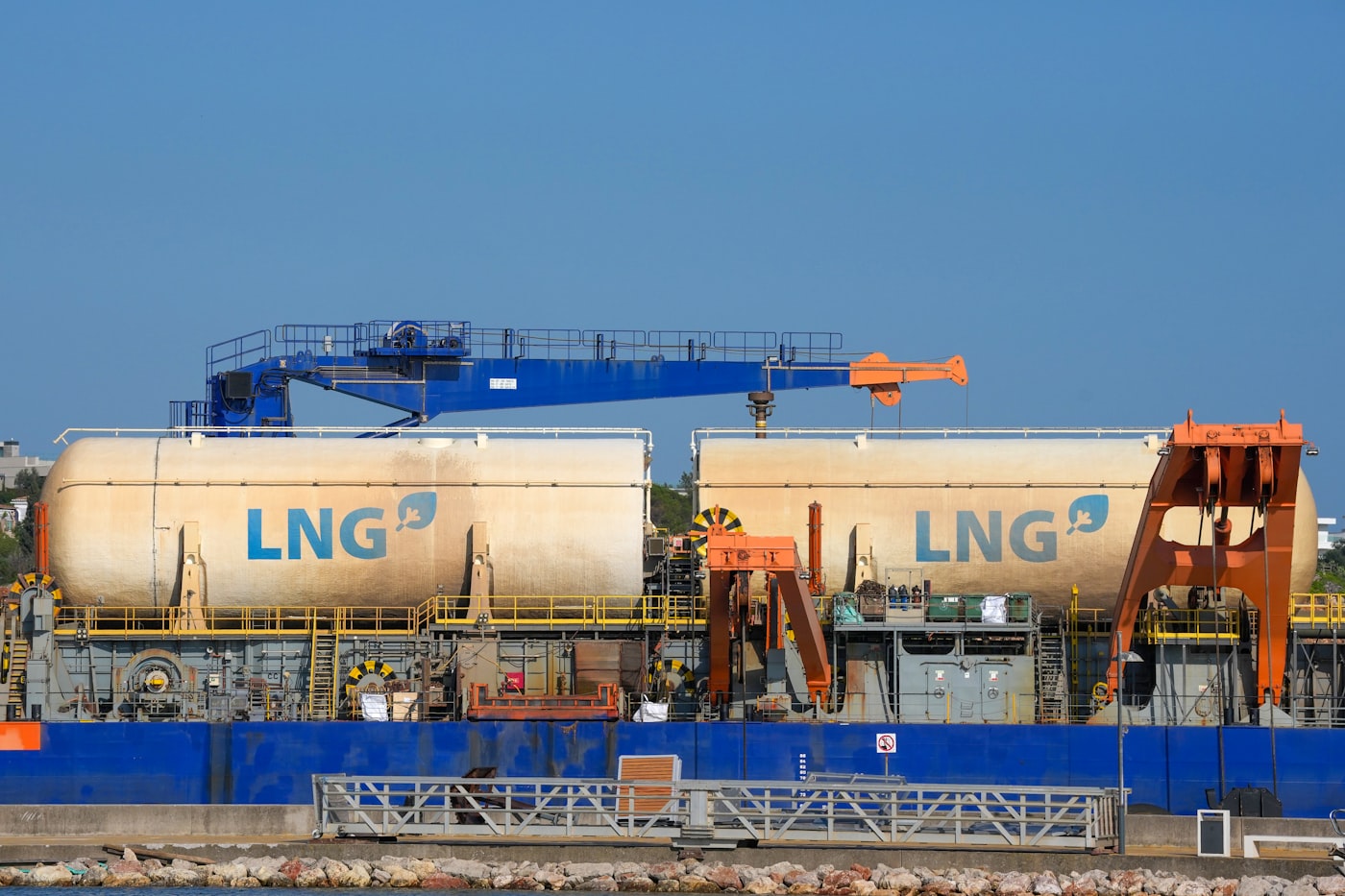
The whole business rests on a single physical fact: chill methane to about minus 162 degrees Celsius and it condenses into a clear liquid that takes up roughly one six-hundredth of the space it occupied as gas. That ratio is the reason a natural gas field in Qatar or Louisiana can supply a power plant in Rotterdam or Tokyo. Pipelines are cheaper over land, but you cannot lay a pipe across the Pacific. So the industry spends enormous amounts of energy and capital to turn gas into a cryogenic liquid, float it across an ocean in an insulated steel thermos, and warm it back into gas at the far end. Every step of that cold chain leaks a little product and costs a lot of money, and those two facts shape global gas trade more than any headline price ever does.
Making the cold: what a liquefaction train actually does
Liquefaction is refrigeration at industrial scale. Feed gas arrives, gets stripped of water, carbon dioxide, sulfur compounds and heavier hydrocarbons that would freeze solid or foul equipment, and then passes through cascades of refrigerant loops that pull its temperature down in stages until it liquefies near minus 162 degrees Celsius. The core hardware that does this is called a train, and a large export terminal runs several of them in parallel. The refrigeration compressors consume more energy than anything else on site, which is why train design is largely an exercise in squeezing out compressor inefficiency.
That energy cost is not trivial. Cooling gas to a liquid burns roughly 5 percent of the gas itself, on the order of 280 kilowatt-hours per tonne of LNG produced, and liquefaction accounts for something close to 30 percent of the total energy consumed across the entire LNG value chain. The capital side is heavier still. Liquefaction plants are priced in dollars per tonne of annual capacity, and at a representative figure of around 400 dollars per tonne per annum, an 8-million-tonne plant runs about 3.2 billion dollars. Individual trains have grown to 3 to 6 million tonnes a year, with the largest single trains in Qatar rated near 7.8 million tonnes. These are among the most expensive discrete pieces of energy infrastructure built anywhere, which is why liquefaction contracts get signed for 15 and 20 years at a time.
Modular is rewriting the cost curve
The old model was a small number of giant trains built on site over five to seven years. That model is now competing with a modular one. Venture Global's Plaquemines plant in Louisiana reached a nameplate of 20 million tonnes a year using 36 parallel mid-scale liquefaction blocks rather than a handful of mega-trains, and produced its first LNG in December 2024, roughly 30 months after the final investment decision. Fabricating standardized blocks in a yard and bolting them together at the coast compresses the schedule and changes the risk math. Cost escalation and multi-year delays have plagued conventional stick-built mega-projects for a decade, so anything that shortens the timeline between spending the money and selling the cargo directly improves the economics.
The steel thermos: membrane versus Moss
Once you have the liquid, you have to keep it cold at sea for weeks, and there is no active refrigeration on the ship. The tanks are simply very good insulation, and the cargo stays cold by allowing a fraction of it to boil off, exactly the way sweat cools skin. Two tank designs dominate. Membrane carriers use thin corrugated stainless or nickel-alloy membranes backed by insulation that follow the shape of the hull, which packs more cargo into a given hull and costs less per cubic meter. Moss carriers use the recognizable free-standing spheres, mechanically robust and structurally independent of the hull. Membrane has won the volume war, holding roughly 70 percent of the carrier market in 2025, while Moss spheres hang on in ice-class and Arctic service where ruggedness beats volumetric efficiency, at something like an 18 percent share.
The conventional workhorse today carries around 174,000 cubic meters. The boil-off gas that keeps the cargo cold is not waste if you plan for it. Older steam-turbine Moss ships boil off around 0.15 percent of cargo per day; modern membrane ships with dual-fuel or tri-fuel diesel-electric engines run closer to 0.10 to 0.125 percent, and burn that boil-off gas as propulsion fuel. The difference sounds tiny until you scale it. On a 174,000-cubic-meter carrier, shaving 0.05 percent per day is roughly 36 tonnes of LNG conserved every day of the voyage. Over a three-week haul that is real cargo that arrives and sells instead of vanishing up the stack, which is precisely why boil-off rate shows up in charter negotiations and emissions math alike.
Warming it back up, fast
At the import end, regasification is the cheap and simple half of the chain in engineering terms, but it is where geopolitics moves fastest. LNG is pumped from storage, warmed back into gas using seawater or combustion heat, and pushed into the pipeline grid. The choice that matters is onshore terminal versus floating unit. A Floating Storage and Regasification Unit, or FSRU, is essentially a moored ship that does the warming on board and sends gas ashore. It can be chartered and brought online in roughly 12 to 18 months, against five to seven years for a conventional onshore terminal.
That speed advantage stopped being an abstraction in 2022. Germany had zero LNG import capacity and leaned on Russian pipeline gas for around 55 percent of its supply when the invasion of Ukraine severed that dependence. Within about 18 months it stood up five state-backed FSRUs at sites including Wilhelmshaven and Lubmin, going from nothing to a functioning import hub. Across the continent the post-2022 wave added on the order of 26 projects and roughly 104 million tonnes a year of new regasification capacity, with nearly 70 percent of it floating precisely because floating comes online first. Germany's own program spans four sites and expects, once fully running, to cover more than 60 percent of national gas demand.
Why the cold chain sets the price
Put the pieces together and the trade logic falls out. Liquefaction is the expensive, slow, long-contract bottleneck, so supply expands in lumpy multi-billion-dollar increments and sellers want decades of certainty before they build. Shipping is a floating constraint measured in vessel availability and boil-off, and when carrier supply tightens, charter rates can swing hard enough to reroute cargoes. Regasification, thanks to FSRUs, is now the flexible shock absorber that lets an importer materialize demand in a year and a half rather than half a decade.
That asymmetry explains the events of the last few years better than any spot quote. Europe could not conjure new liquefaction, so it bid for existing cargoes and raced to build the one piece it could build fast. The price of gas delivered across an ocean is, in the end, the price of cold: the energy to make it, the steel to hold it, and the fraction that boils away in transit. Understand the cold chain and you understand why the gas map looks the way it does.
Sources
https://www.eia.gov/energyexplained/natural-gas/liquefied-natural-gas.phphttps://thundersaidenergy.com/downloads/lng-process-technologies-an-overview/https://lngnavigator.eu/moss-type-lng-carriers/https://www.mordorintelligence.com/industry-reports/lng-carriers-markethttps://www.rystadenergy.com/russia-ukraine-conflict-spurs-europe-s-fsru-drivehttps://perkinsgreg.substack.com/p/redefining-lng-mega-projects