The Catalytic Cracker: The Beating Heart That Turns Sludge Into Gasoline
The fluid catalytic cracker takes the heavy gas oil nobody wants and cracks it into the gasoline and propylene that pay a refinery's bills, and how a refiner runs it decides what comes out the back gate.

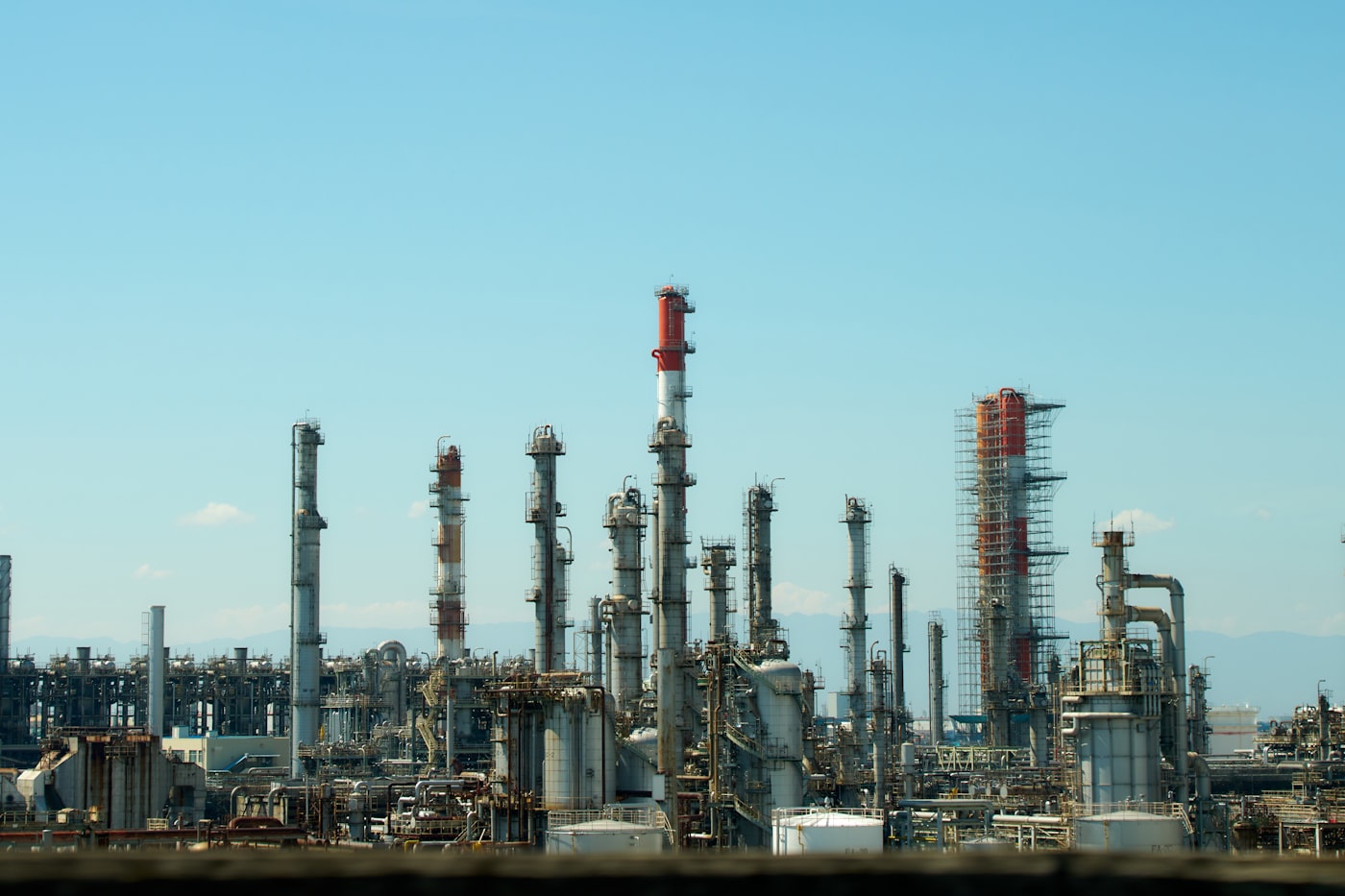
Walk the fenceline of a gasoline-oriented US refinery and the tallest, loudest, most temperamental structure you will see is usually not the crude tower. It is the fluid catalytic cracker. Two vessels stacked and cross-linked by pipes as thick as a car, one running near 1,000 degrees Fahrenheit and the other hotter still, with a fine white powder pouring between them like sand through an hourglass at a rate measured in tons per minute. That powder is the whole game. The FCC is where the bottom of the barrel, the tarry heavy gas oil that would otherwise sell as cheap fuel oil, gets torn apart and rebuilt into the gasoline that moves the country.
What actually happens in the riser
Start with the feed. After crude has been distilled and the light stuff pulled off the top, what is left includes vacuum gas oil and other heavy gas oils, long carbon chains too big and too heavy to burn in an engine. The cracker's job is to cut those chains down to gasoline length, roughly five to twelve carbons.
The reaction happens in the riser, a vertical pipe where preheated gas oil vapor meets a stream of scorching powdered catalyst. Contact time is short, on the order of a couple of seconds, but it is violent. At close to 1,000 degrees Fahrenheit the big molecules fracture on the catalyst's acid sites into gasoline-range hydrocarbons, light olefins like propylene and butylene, and lighter gases. The catalyst is not just hot ballast. It is a zeolite, a crystalline aluminosilicate whose pores and acid sites steer which bonds break, which is why refiners talk about catalyst the way winemakers talk about yeast.
The catalyst behaves like a liquid, which is where the word fluid comes from. Suspended in rising vapor, the powder flows, sloshes, and circulates as if it were poured. That single trick, fluidizing a solid so it can be pumped continuously between two vessels, is what separates the modern FCC from the batch crackers of the 1930s and 40s.
Why the unit never stops
Cracking has a built-in problem. Every pass lays down coke, a hard carbon residue, on the catalyst surface, and coke kills activity fast. A batch process would have to shut down to clean it. The FCC instead cheats time by running two connected vessels at once.
Spent, coked-up catalyst drops out of the reactor and flows into the regenerator, where air is blown through the bed and the coke is simply burned off. That combustion runs hot, commonly in the 1,300 to 1,400 degree Fahrenheit range, and it does double duty: it restores the catalyst and it generates the heat the reaction side needs. The freshly cleaned, reheated catalyst circulates back to the base of the riser to meet the next slug of feed. Reaction, coking, regeneration, back to reaction, thousands of times a day, continuously, for years between turnarounds.
That heat balance is the quiet genius of the design. The endothermic cracking reactions are fed by the exothermic coke burn, and an operator tunes the whole unit by nudging the catalyst circulation rate and the catalyst-to-oil ratio. Regenerator efficiency is not a housekeeping detail; it drives the heat balance and, with it, the unit's profitability, which is why so much engineering effort goes into regeneration technology.
The workhorse versus the specialist
Ask why the FCC dominates American refining and the answer is product slate. The United States runs a gasoline-heavy demand barrel, and the FCC is the cheapest, highest-throughput way to make gasoline out of heavy feed. It is, bluntly, the best available option for cracking petroleum fractions on cost, which is why it sits at the center of conversion refineries here.
The other route is hydrocracking, and the difference is philosophical as much as chemical. A hydrocracker adds hydrogen at high pressure over a different catalyst and tends to swing product toward middle distillates, diesel and jet, with cleaner, more saturated output. That makes hydrocracking the tool of choice in distillate-oriented markets, much of Europe and parts of Asia where diesel demand runs ahead of gasoline. The FCC, by contrast, rejects carbon as coke rather than adding hydrogen, so it leans naturally toward gasoline and light olefins. Neither is better in a vacuum. They are answers to different questions about what the local market wants to buy.
The economics show up in the crack spread, the margin between the price of finished products and the crude that made them. Through 2025 the EIA reported elevated product crack spreads, with the diesel spread reaching about 85 cents per gallon in July 2025, its highest since early 2024, and gasoline spreads running well above the prior year; it expects lower crude and retail gasoline prices heading into 2026. A refiner living on that spread cares intensely about how many gallons of gasoline each barrel of gas oil yields, and the FCC is the lever that moves that number.
Tuning the yield: gasoline or propylene
Here is where the FCC stops being a fixed box and becomes a dial. The same unit can be pushed toward more gasoline or toward more propylene and light olefins, and refiners do exactly that depending on which product is paying better.
The main tools are catalyst and severity. The base cracking catalyst is a zeolite Y system built for gasoline. To chase olefins, refiners blend in a shape-selective additive, most commonly ZSM-5. Introduced originally as a gasoline octane booster, ZSM-5 cracks gasoline-range molecules further into propylene and butylene. A conventional FCC makes roughly four to six percent propylene by weight; adding ZSM-5 lifts that by a point to several points, and units purpose-built for petrochemicals, running higher reactor temperature and more catalyst additive, can push propylene toward twenty percent of the product.
None of that is free. When you crank up olefin production, gasoline yield gives ground, because you are cracking the very molecules that would have been gasoline. Operators also modify the catalyst chemistry itself, using phosphorus stabilization to improve durability and dopants such as iron oxide and boron oxide to shift toward more isobutene and LPG while making less coke. The lever is not just how hard you run the unit but what powder you feed it.
This flexibility is why the FCC is increasingly discussed as a petrochemical asset, not only a fuels asset. Petrochemical feedstock is expected to take a growing share of oil demand in the decades ahead, and the FCC is one of the lowest-energy ways to make propylene at scale. The same vessel that was built to feed gas tanks is being retasked, catalyst tray by catalyst tray, to feed plastics plants.
The bottom line
Every refinery has a crude unit. What makes a refinery a money-maker rather than a fuel-oil factory is what it does with the heavy stuff the crude unit leaves behind, and in the US that answer is almost always the fluid catalytic cracker. It sets how much gasoline a barrel yields, it swings between fuels and petrochemicals on command, and its heat balance quietly underwrites the margin. Watch a refiner's decisions and you are usually watching decisions made about the cracker. Sludge in one end, gasoline and propylene out the other, and a spread to defend in between.
Sources
https://courses.ems.psu.edu/fsc432/node/712https://www.sciencedirect.com/topics/chemistry/fluid-catalytic-crackinghttps://www.digitalrefining.com/article/1002816/role-of-fcc-process-and-catalysts-in-the-energy-transitionhttps://www.mdpi.com/1996-1073/15/6/2061https://www.eia.gov/todayinenergy/detail.php?id=66264https://www.eia.gov/todayinenergy/detail.php?id=64324